How to Clean Gutters Safely: A Complete Step-by-Step Guide

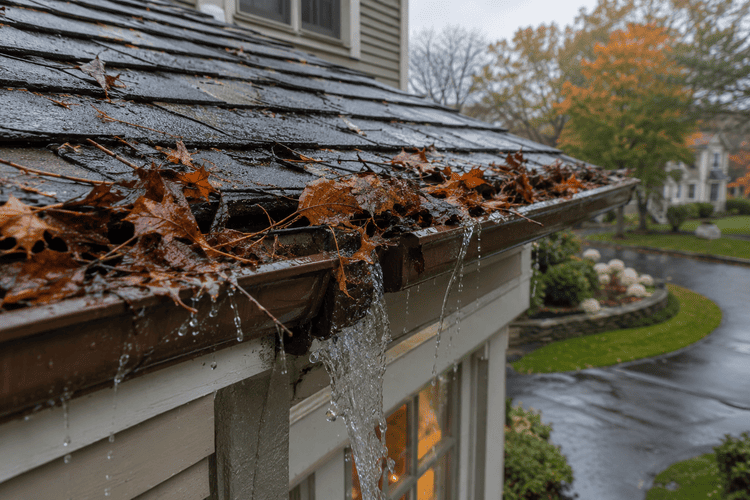
There’s a specific sound a gutter makes right before it gives up on you — a low gurgle during a rainstorm, water sheeting over the edge instead of through the downspout. If you’ve heard it, you already know the feeling of climbing up to look and finding a solid mat of decomposed leaves, shingle grit, and standing water where a clear channel should be. That mat is doing real damage every day it sits there, and clearing it isn’t complicated, but it does need to be done correctly.
This guide walks through the actual process — tools, timing, technique — including the methods for houses where a straight ladder climb isn’t realistic or safe.
Why Clogged Gutters Are More Than a Cosmetic Problem
A gutter system has one job: move water away from your roofline, siding, and foundation before it can pool. When leaves, seeds, and granules from asphalt shingles build up, that water has nowhere to go. It backs up under the roof edge, which is how fascia boards start to rot and how ice dams form in January along the Northeast. It overflows straight down the siding, staining it and, over a few seasons, softening the trim behind it. And it dumps next to the foundation instead of six feet away, which is a slow but reliable way to end up with a wet basement.
None of this happens overnight. It happens gradually enough that a lot of homeowners don’t connect a foundation crack in spring to a gutter that’s been clogged since October. Regular cleaning is what keeps that chain of events from starting.
How Often Gutters Actually Need Attention
The generic advice is twice a year — spring and fall — and for a lot of properties that’s genuinely enough. But “twice a year” assumes a fairly average lot. A few things push that number up:
- Mature oaks, maples, or pines within dropping distance of the roof — these shed over a longer window than people expect, and pine needles in particular clog faster than broad leaves because they mat together.
- A low-slope or valley-heavy roof design, which channels more debris into fewer gutter runs.
- A history of ice dams — if water backed up last winter, the gutters were probably already partially blocked going into the cold.
Houses surrounded by trees often do better on a quarterly schedule, or at minimum a check after the first hard leaf-drop and again once everything is bare. If you’re not sure which category your house falls into, a five-minute look from a ladder after a heavy rain will tell you — dry channels with water flowing freely mean you’re fine; anything damp and packed means it’s time.
What You Need Before You Start
Skipping this part is how most gutter-cleaning injuries happen. A basic kit:
- A ladder rated for your weight plus tools, with a stand-off stabilizer that hooks over the gutter edge instead of resting the ladder rails against it (this alone prevents most of the crushed-gutter damage DIYers cause)
- Heavy-duty gloves — leather or thick rubber, not garden gloves, since wet debris hides sharp shingle grit and the occasional nail
- A small plastic gutter scoop or an old spatula
- A bucket or tarp to drop debris into rather than onto the lawn or driveway
- Safety glasses, especially when flushing with a hose afterward
- A garden hose with a spray nozzle for the final flush
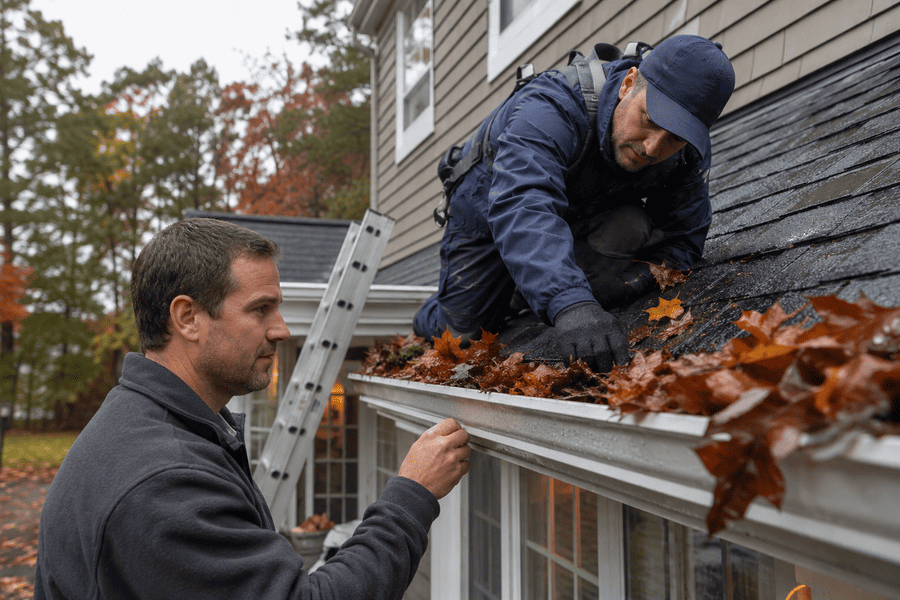
If you’re working above a single story, add a second person to hold the ladder and a phone in your pocket. Solo, second-story ladder work is where the genuinely serious accidents happen, and it’s worth saying plainly: this is the point where hiring it out stops being about convenience and starts being about risk.

The Standard Method: Cleaning From a Ladder
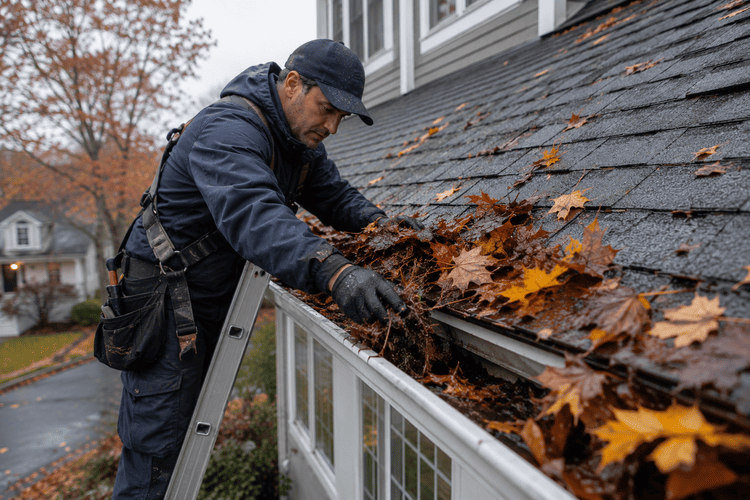
- Position the ladder correctly. Set it on level ground at a stable angle, with the stabilizer bar resting against the roofline above the gutter, not the gutter lip itself. Move the ladder every 4-6 feet rather than overreaching sideways.
- Clear the bulk debris by hand. Working away from the nearest downspout, scoop out leaves and sludge into your bucket. Going toward the downspout just pushes debris into it and creates a clog you’ll fight later.
- Flush with the hose. Starting at the far end from the downspout, run water through the channel to clear the fine grit the scoop missed and confirm the slope is actually draining.
- Check the downspout itself. If water backs up instead of disappearing down the pipe, it’s blocked — more on clearing that below.
- Look at the hardware while you’re up there. Loose hangers, separated seams, and a gutter pulling away from the fascia are all easy to spot mid-cleaning and much harder to notice from the ground later.
Cleaning Gutters Without a Ladder
For single-story sections, or for anyone who’d rather not be on a ladder at all, ground-level tools have gotten genuinely good in the past couple of years:
- A gutter-cleaning wand — a rigid, curved extension that attaches to a garden hose and lets you flush debris out from the ground, working the same far-end-to-downspout direction as the ladder method.
- A telescoping gutter scoop or leaf blower attachment — these clip onto a extension pole and let you rake out drier, lighter debris before flushing, which is faster than flushing alone when the buildup is heavy.
- A wet/dry vacuum with a curved gutter attachment — works well for single-story homes and is oddly effective on the slushy, half-composted debris that accumulates over winter.
None of these fully replace a hands-on inspection — you won’t spot a separating seam from the driveway — but for routine mid-season maintenance on reachable gutters, they’re a legitimate way to skip the ladder entirely.
Second-Story and Steep-Roof Homes
This is where the calculation changes. An extension ladder tall enough to reach a second-story gutter is heavier, harder to place safely, and puts you working at a height where a fall isn’t a sprained ankle. A few adjustments if you’re doing it anyway: use a ladder rated well beyond the height you need, never stand above the third rung from the top, and have someone below the entire time, not just while you’re climbing.
Realistically, this is the scenario where most professional gutter-cleaning calls come from — not because homeowners can’t scoop leaves, but because doing it safely above one story requires equipment most people don’t own and don’t want to buy for a twice-a-year task.
Don’t Skip the Downspouts
A gutter can be spotless and still overflow if the downspout below it is blocked. Signs of a clogged downspout include water sheeting out of the gutter corner above it, a gurgling sound during rain, or a downspout that stays dry while everything around it is soaked.
To clear one: remove the bottom elbow if it has one, and run a hose upward from the bottom opening — this dislodges debris downward, away from the direction it packed in. If that doesn’t clear it, a plumber’s snake or a length of stiff wire works for stubborn compacted clogs. Reattach the elbow and confirm water exits cleanly at the base before moving on.
If You Have Gutter Guards Installed
Guards cut down on maintenance, but “cut down” isn’t “eliminate,” and that’s a distinction that gets lost in a lot of the marketing around them. Fine particles — shingle grit, seed pods, pine needle fragments — still work through most mesh and screen systems over a couple of seasons, and they settle in a thin layer along the gutter floor. It’s a fraction of what an unprotected gutter collects, but it’s not nothing.
For most guard styles, an annual check is enough: lift or open the guard section by section, brush out any accumulated silt, and flush as usual. Solid-cover and reverse-curve guards typically need less frequent attention than mesh or screen types, since they shed more debris automatically.
What Professional Cleaning Costs, and When It’s Worth It
Pricing varies by house size, story height, and how neglected the gutters are, but a straightforward single-story cleaning typically runs in the low hundreds, with second-story and heavily wooded properties landing higher due to the added time and equipment. For a lot of homeowners, the math comes down to trading an afternoon and some risk tolerance for a fixed cost — reasonable either way, depending on the house.
Where it stops being a close call: steep roof pitches, any second-story work without proper fall protection, gutters that haven’t been touched in a couple of years, or a history of ice dams. In those situations, the time saved isn’t really the point — it’s that the job requires equipment and technique most homeowners aren’t set up for, and a fall from a roofline is not a risk worth taking to save an afternoon.
Quick Answers
How long does cleaning gutters actually take?
For an average single-story home, budget 1-2 hours. Second stories, heavy tree cover, or gutters that haven’t been done in over a year can push that toward half a day.
Can I use a pressure washer instead of a hose?
You can, but on low settings only — full pressure can separate gutter seams or dent aluminum sections. A standard hose nozzle is usually enough once the bulk debris is scooped out.
What’s the best time of year to do it?
Late fall, after the last leaves have dropped, and again in spring once seed pods and winter debris have settled. Doing it before the leaves are fully down just means doing it again a few weeks later.
Do gutters with guards ever need professional attention?
Occasionally — if silt has built up under the guard system for several years without a check, removing and cleaning the guards themselves is a bigger job than a routine flush, and that’s a reasonable point to bring in a crew rather than disassemble the system yourself.
Cleaning your own gutters is entirely doable for most single-story homes with the right tools and a little patience. Where it gets genuinely risky — second stories, steep pitches, gutters that have been neglected for a while — it’s worth having a second opinion before you’re the one on the ladder. If that’s where your house falls, Elite Gutter Care handles the inspection and cleaning end of things for homes across Stamford and Fairfield County, ladder work included.