What Are Seamless Gutters (And What Do They Actually Cost)?
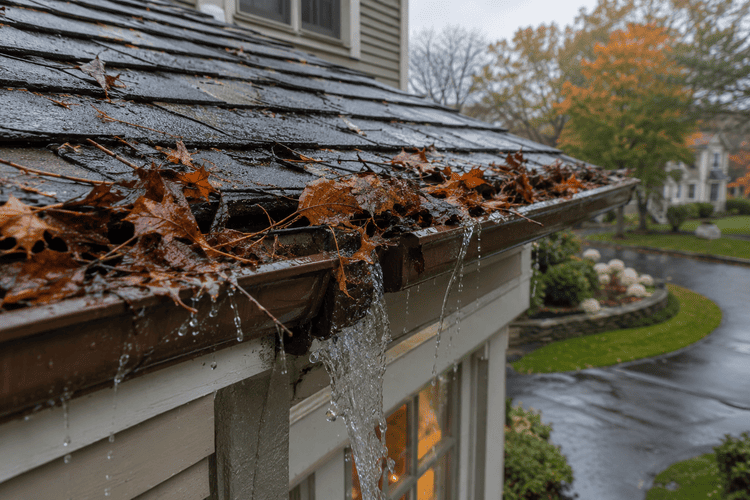
If you’ve ever noticed a gutter with visible joints every ten feet, each one a slightly darker line where two sections were bolted together, that’s a sectional system — and every one of those joints is a place water can eventually work its way through. Seamless gutters solve that specific problem by not having joints at all, except at corners and downspout drops. Here’s what that actually means, what it costs, and when the extra money is worth spending.
Quick Answer on Cost
Seamless aluminum gutters typically run $6 to $12 per linear foot installed, putting an average home (150–200 feet of gutter) at roughly $1,000 to $2,400 total. Steel runs somewhat higher, and copper — which is chosen more for appearance and longevity than economy — can run $20 to $40+ per foot. Sectional aluminum gutters, for comparison, are usually $3 to $6 per foot, which is the main reason people ask whether seamless is worth the difference. More on that below.
What “Seamless” Actually Means
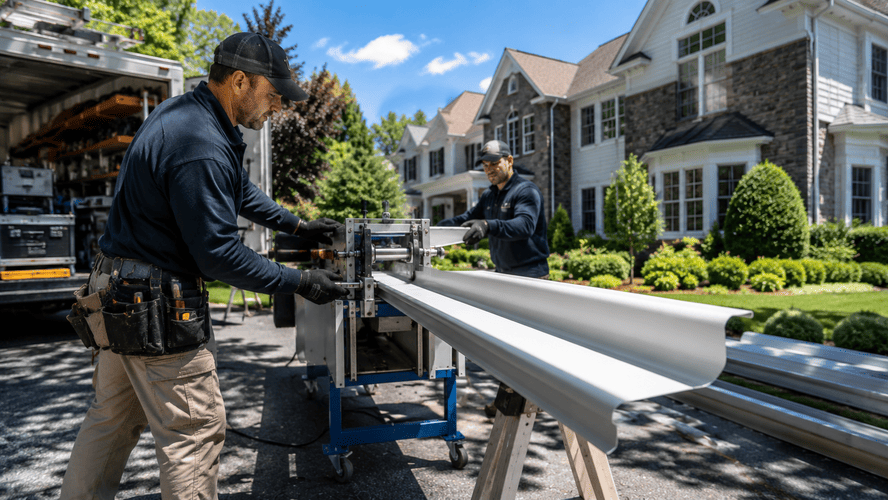
Sectional gutters are manufactured in fixed lengths — usually 10 feet — trucked to the site, and joined together with connectors and sealant at every seam. Seamless gutters skip that entirely: the installer brings a portable roll-forming machine, feeds in a coil of flat aluminum (or steel or copper), and the machine shapes it into gutter profile in one continuous run cut to the exact length of your roofline, right there in your driveway. A 40-foot stretch of roof gets a single 40-foot piece of gutter, with joints only where the direction changes at a corner or where a downspout connects.
That’s also why seamless gutters can’t be bought off a shelf — they’re formed to order on-site, which is part of what separates the installed cost from a DIY sectional kit from a hardware store.
Seamless vs. Sectional: What Actually Changes
The practical difference comes down to fewer places for water to escape. Every seam in a sectional system is a potential leak point once the sealant ages, typically starting to show wear somewhere in the 5-to-10-year range depending on climate. Seamless systems only have those failure points at corners and outlets — often just two or three per gutter run instead of a dozen — so leaks are both less frequent and easier to trace when they do happen.
There’s also a visual difference that matters to some homeowners and not at all to others: a continuous run reads as a single clean line, where sectional systems show a faint seam every ten feet if you look for it. Structurally, both types perform similarly when installed correctly — the seamless advantage is really about long-term leak resistance and lower maintenance, not dramatically better water-handling capacity.
What Drives the Price
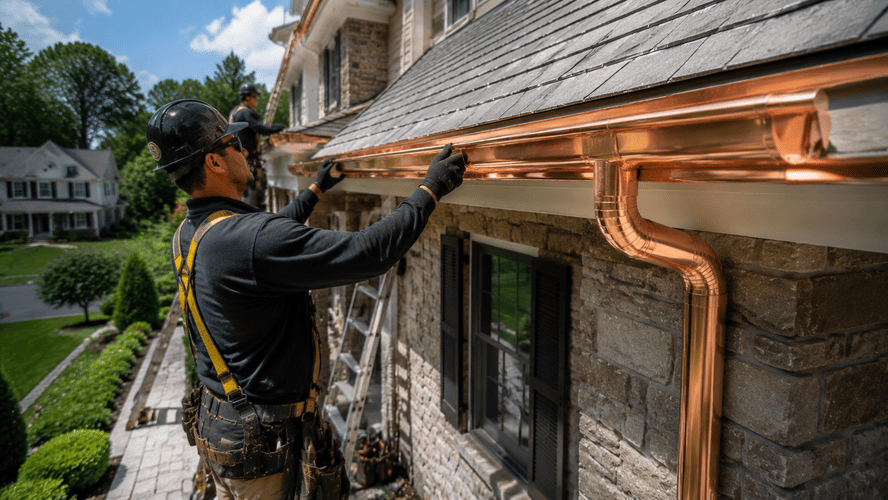
Material. Aluminum is the standard choice and the price anchor point above. Galvanized or painted steel runs 20–40% higher due to material cost and heavier equipment needed to form it. Copper is in a different category entirely — it’s priced more like a specialty architectural feature than a functional upgrade, chosen for how it weathers to a green-brown patina over the decades rather than for cost efficiency.
Home size and story count. More linear footage is the obvious factor, but second-story work also adds labor time and safety equipment, which shows up in the per-foot labor rate even though the material cost per foot doesn’t change.
Removal of old gutters. If you’re replacing an existing system, factor in disposal — most quotes include it, but it’s worth confirming, since hauling away old sectional gutters and hardware isn’t free for the installer either.
Color and gauge. Standard mill-finish or common colors are baked into the base price; custom color matching and heavier-gauge aluminum (.032″ instead of the common .027″) both add a modest premium, generally in the range of an extra dollar or so per foot.
Corners and outlets. A simple rectangular roofline with four corners costs less to finish than a house with multiple roof valleys, dormers, and offsets, since each corner requires a mitered joint formed and sealed by hand rather than the continuous machine run.
How the Installation Actually Goes
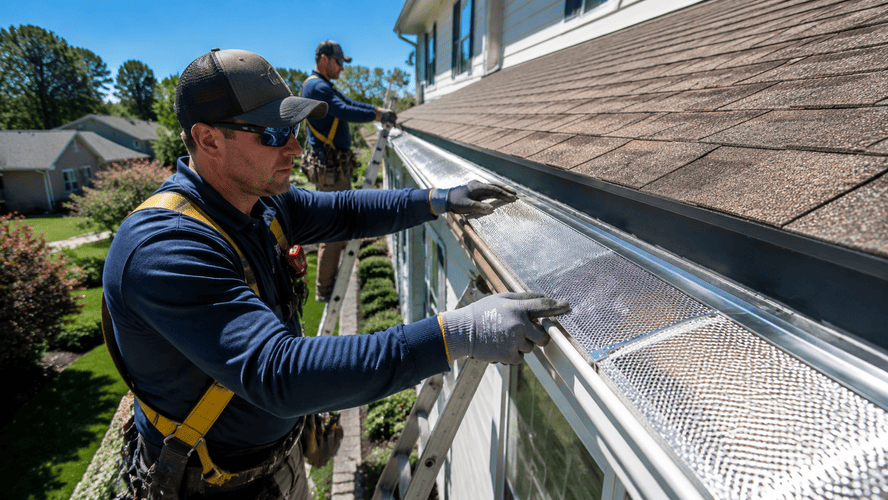
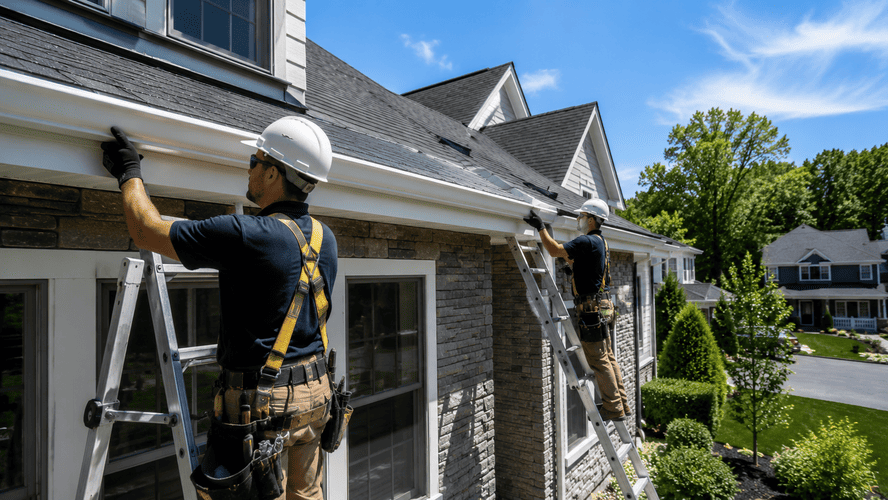
Most jobs are done in a single day for an average-sized home. The crew measures the roofline, loads the coil stock into the forming machine, and runs each length directly below where it will be hung — there’s no need to transport long, awkward gutter sections, since nothing exists in finished form until it comes out of the machine on-site. Sections are then lifted into place, corners are mitered and sealed, hangers are set (ideally every 24–36 inches, tighter in regions with heavy snow load), and downspouts are connected at the calculated low points.
Because the gutter is formed to the exact roofline length, there’s very little material waste and almost no adjustment needed on the wall — which is part of why seamless installation, despite sounding more technical, often isn’t dramatically slower than a sectional job on a comparable house.
Is the Extra Cost Worth It?
For most homes, yes — the reasoning is straightforward. Sectional gutters cost less upfront, but the seams are the first thing to fail, usually well before the metal itself wears out, and repairing individual leaking joints over the years adds up in both money and hassle. Seamless systems shift that cost forward into the initial installation instead of spreading small repair bills across a decade.
Where the math is less clear-cut: very short or simple gutter runs, rental properties where minimizing upfront cost matters more than 15-year performance, or situations where a full gutter replacement isn’t really needed yet and patching an existing sectional system is the more sensible near-term move. Seamless gutters are a durability investment, not a requirement for every property.
Choosing Who Installs Them
The roll-forming machine is the easy part to get right — the miters, the hanger spacing, and the pitch calculation (a proper slope toward the downspout, usually about a quarter-inch of drop per ten feet) are where installation quality actually shows up years later. A gutter that looks fine on day one but was hung dead level instead of pitched will pool water and collect debris faster regardless of how seamless it is. When comparing quotes, ask specifically about gauge, hanger spacing, and whether old gutters and disposal are included — those three details account for most of the real difference between bids that otherwise look similar on paper.
Quick Answers
What are seamless gutters made of?
Most commonly aluminum, formed on-site from coil stock. Steel and copper are available for homeowners who want added durability or a specific architectural look, both at a higher price point.
How much do seamless gutters cost per foot?
Aluminum typically runs $6–$12 per linear foot installed. Steel is somewhat higher, and copper is significantly higher, generally $20–$40+ per foot.
Are seamless gutters worth it over sectional gutters?
For most homes, yes, over a multi-year horizon — fewer seams means fewer leak points and less ongoing repair. Sectional remains a reasonable lower-cost option for simple, short runs or short-term ownership situations.
How long do seamless gutters last?
Well-installed aluminum seamless gutters typically last 20+ years; steel and copper often longer, with copper systems commonly outlasting the house’s other exterior components entirely.
Getting an exact number for your home depends mostly on linear footage, material, and how many corners the roofline has — the ranges above should make any quote easy to sanity-check. Elite Gutter Care installs seamless aluminum gutters on-site across Stamford and Fairfield County, with the forming machine brought to your home the same day.