Gutter Guards Cost: What You’ll Actually Pay
Ask five contractors what gutter guards cost and you’ll get five different numbers, mostly because “gutter guards” isn’t one product — it’s a category that runs from a $3 clip-on screen at the hardware store to a $25-per-foot heated micro-mesh system installed by a crew. Here’s the number-by-number version, without the sales pitch.
The Short Answer
For a typical house with around 150–200 linear feet of gutter, professionally installed gutter guards run roughly $1,500 to $4,500 total, or about $7 to $25 per linear foot installed, depending on the guard type. Basic screen or brush inserts you install yourself land closer to $1 to $5 per foot in materials only. Premium micro-mesh systems with a warranty and professional install sit at the top of that range.
That range is wide on purpose — the type of guard changes the number more than almost anything else, which is worth walking through before you get a quote.
What Actually Moves the Price
A few variables account for most of the difference between a $1,500 job and a $4,500 one:
Linear footage. This is the baseline — guards are priced per foot, so a larger roofline costs more regardless of guard type. A ranch with 120 feet of gutter and a colonial with 240 feet are two very different invoices even with the identical product.
Roof height and pitch. Second-story work and steep pitches mean more time, more safety equipment, and often a second crew member — installers price that in.
Condition of the existing gutters. If the gutters underneath are sagging, undersized, or already damaged, guards get installed on top of a problem instead of solving it. Some installers will flag this and recommend gutter replacement first, which changes the scope of the job.
Guard material and design. This is the single biggest swing factor, covered in detail below.
Installer overhead. A national franchise with a sales process, lifetime warranty, and financing options costs more per foot than a local gutter company installing the same category of guard with less overhead — not because the product is different, but because the business model is.
Cost by Guard Type
Mesh screens (aluminum or plastic, snap-on): $1–$3 per foot in materials for a DIY box-store version; $4–$8 per foot installed. These block larger debris but let fine grit and pine needles through over time, so they still need occasional attention.
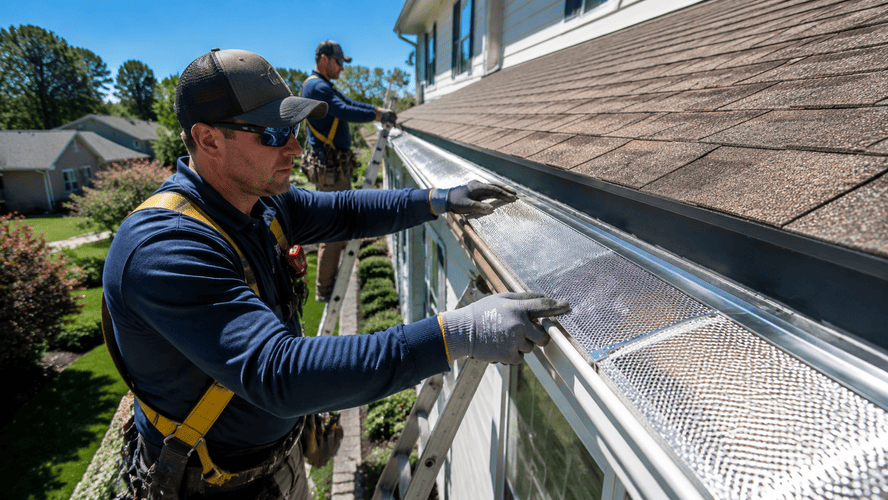
Micro-mesh systems: $7–$15 per foot installed, sometimes higher with a name-brand warranty attached. The fine stainless or aluminum mesh keeps out nearly everything, including shingle grit, which is why this category dominates the professionally-installed market.
Reverse-curve (surface tension) guards: $8–$20 per foot installed. Water follows the curve of the guard into the gutter while debris slides off the front edge. Effective, but the design is less forgiving of an installation that’s slightly off-angle, so labor quality matters more here than with mesh.
Brush inserts: $2–$5 per foot, almost always DIY. Cheap and easy to install, but they trap fine debris inside the bristles rather than shedding it, which means more maintenance than the marketing suggests.
Foam inserts: $5–$10 per foot, also typically DIY. Debris sits on top of the foam and (in theory) blows or washes off, but foam degrades faster in direct sun than the other categories and usually needs replacing within several years.
Heated guard systems: $12–$25 per foot installed. These add embedded heat cables to melt ice buildup along the edge, which is a genuinely useful add-on in regions that deal with ice dams, but it’s the most expensive category by a wide margin and adds an electrical component to maintain.
How Brand Positioning Affects the Number
Without pinning exact prices on any specific product — those change by market and by promotion, and a number printed today is often wrong in six months — it’s fair to say the market splits into three rough tiers. Big-box and online screen/brush products sit at the low end and are sized for DIY installation. Regional and national installed micro-mesh brands (the ones running heavy local advertising and offering transferable warranties) sit in the middle-to-upper range, and that premium is paying for the sales process, warranty paperwork, and financing as much as the mesh itself. Specialty systems — heated cable, reverse-curve with proprietary profiles — sit at the top regardless of who installs them, because the manufacturing is more complex.
The practical takeaway: get the actual guard type and material spec in writing before comparing quotes. Two installers quoting “premium micro-mesh” a few dollars apart per foot are an apples-to-apples comparison. A $6-per-foot screen quote next to a $16-per-foot micro-mesh quote isn’t a price difference — it’s two different products.
DIY vs. Professional Installation
Materials-only DIY guards (brush, foam, basic screen) are genuinely a reasonable weekend project for a single-story home with straightforward gutter runs — expect to spend a few hundred dollars total for an average house and a Saturday’s worth of ladder work.
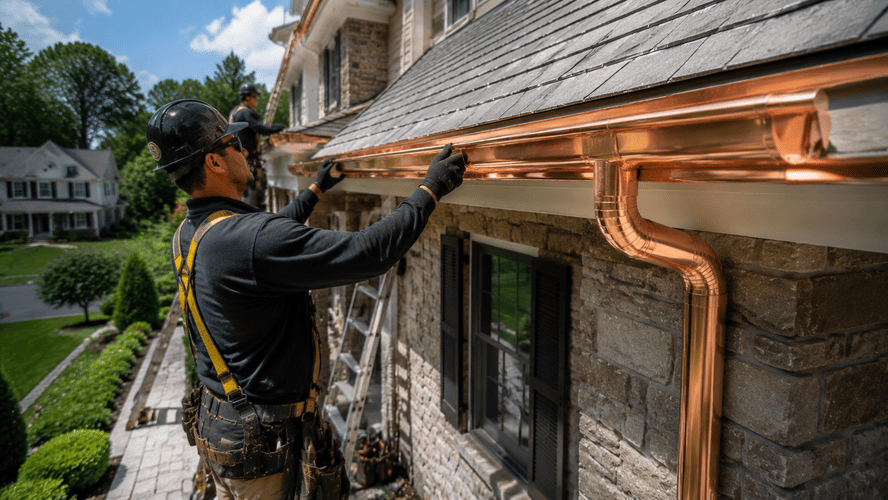
Professional installation adds labor cost on top of the material price, typically landing between $2 and $6 per foot depending on the region and the crew, and it buys a few things DIY doesn’t: guards that are actually cut and fastened to fit your specific gutter profile (a common failure point with universal-fit box store guards), a warranty that covers workmanship rather than just materials, and — for second-story or steep-roof homes — someone else assuming the fall risk instead of you.
Are Gutter Guards Worth the Cost?
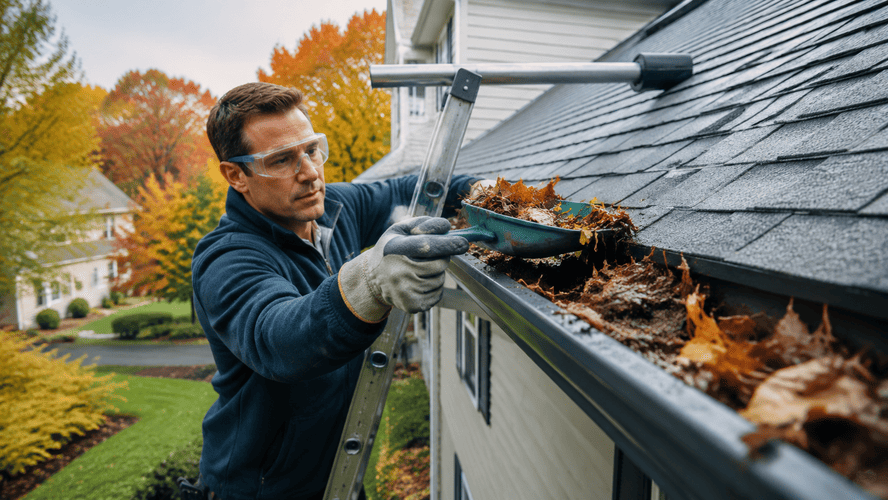
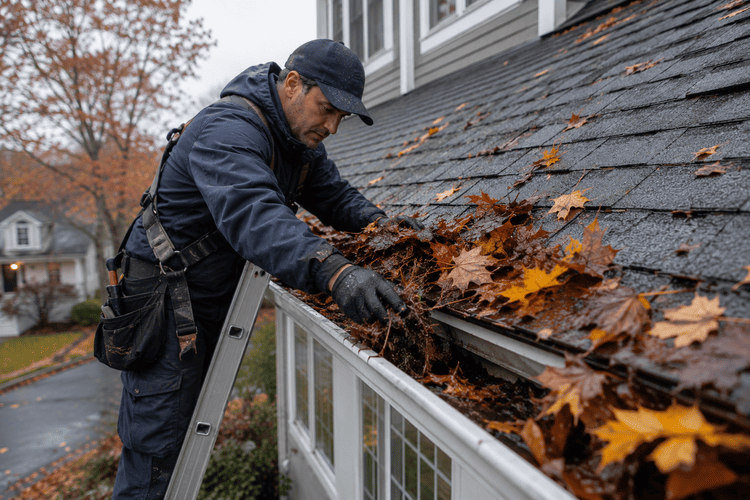
This is really a math question, not an opinion one. If professional gutter cleaning runs $150–$300 per visit and you’re doing it twice a year, that’s $300–$600 annually indefinitely. A mid-range micro-mesh installation at, say, $3,000 for an average home pays for itself against that ongoing cost in roughly five to ten years — and most quality guard systems are rated to last considerably longer than that, with an occasional light rinse instead of a full cleaning.
Where the math gets murkier is on properties with heavy pine cover or unusual roof geometry, where even good guards need periodic attention anyway — the payback period stretches out, though it doesn’t disappear. And guards don’t eliminate every gutter problem: a sagging hanger or a separated seam underneath the guard is still a sagging hanger, just harder to spot without removing a section to look.
Ways to Bring the Number Down
Installing guards at the same time as new gutters is usually cheaper than adding them later, since the crew is already on-site with the same equipment. Guarding only the sections that actually collect debris — often just the runs under overhanging trees — instead of the whole house is a legitimate way to cut cost on properties where only part of the roofline is a problem. And scheduling outside of peak fall season, when installers are booked solid, sometimes opens up better pricing simply because of availability.
Quick Answers
How much do gutter guards cost per foot?
Materials-only DIY options run $1–$5 per foot. Professionally installed systems typically run $7–$25 per foot depending on the guard type, with micro-mesh and reverse-curve systems in the middle-to-upper part of that range.
How much does gutter guard installation cost, separate from materials?
Labor alone typically adds $2–$6 per linear foot, more for second-story or steep-pitch homes.
Are gutter guards worth the cost?
For most homes, yes, measured against the ongoing cost of professional cleanings over several years — though the payback period depends heavily on tree cover and roof design, and guards reduce maintenance rather than eliminate it entirely.
Is it cheaper to install gutter guards with new gutters, or add them later?
Almost always cheaper to bundle them with a gutter replacement, since it avoids a separate service call and setup cost.
Getting an accurate number for your own house really does come down to linear footage, roof height, and which guard category you’re comparing — the range above should make it easy to tell whether a quote you’ve received is in the right neighborhood. If you’d like an exact figure for your home, Elite Gutter Care provides free on-site quotes for gutter guard installation across Stamford and Fairfield County.