Signs Your Gutters Need Repair: 12 Warning Signs and What They Mean
Most gutter damage builds up slowly. A seam starts to drip, a hanger loosens, a stretch of gutter dips a little lower every winter. Nothing looks urgent until water shows up in the basement or a section comes down in a storm. Broken gutters usually give warning signs first, and most of them are visible from the ground.
Short answer
- The clearest signs of broken gutters are sagging sections, leaks at seams and corners, gutters pulling away from the fascia, rust or holes, and water stains on the siding below.
- Puddles, washed out mulch or erosion along the house usually mean the gutters or downspouts are not carrying water where it should go.
- A clogged gutter overflows along its length. A broken gutter drips from one spot. A badly pitched gutter holds standing water away from the downspout.
- Isolated problems such as one leaking seam or a few loose hangers are usually repairable. Widespread rust, many failing seams or rotted fascia along long runs often point to replacement.
- Homeowners insurance may cover storm damage to gutters but generally not wear and tear.
In this article
12 signs your gutters need repair at a glance
| Sign | What it usually means | How soon to act |
|---|---|---|
| Sagging in the middle of a run | Loose or too few hangers, or weight from debris and ice | Soon, before the next snow |
| Drips at seams and corners | Failed sealant or separated joints | Soon |
| Gutter pulling away from the fascia | Fasteners pulled out of soft or rotted wood | Right away |
| Rust spots, cracks or holes | Metal wearing through, common on older steel gutters | Soon |
| Streaks or stains on siding | Water spilling over or leaking for a long time | Check the gutter above |
| Loose or detached downspout | Broken straps or a separated elbow | Soon |
| Water running behind the gutter | Gap at the roof edge, missing drip edge or a gutter set too low | Soon |
| Peeling paint on trim near gutters | Repeated wetting from overflow or leaks | Check the gutter above |
| Puddles or erosion along the house | Overflow, leaks or downspouts emptying too close | Soon |
| Soft or dark fascia boards | Wood rot behind the gutter | Right away |
| Screws, spikes or brackets on the ground | Fasteners backing out | Soon |
| Standing water in the trough | Wrong pitch or a low spot from sagging | Before winter |
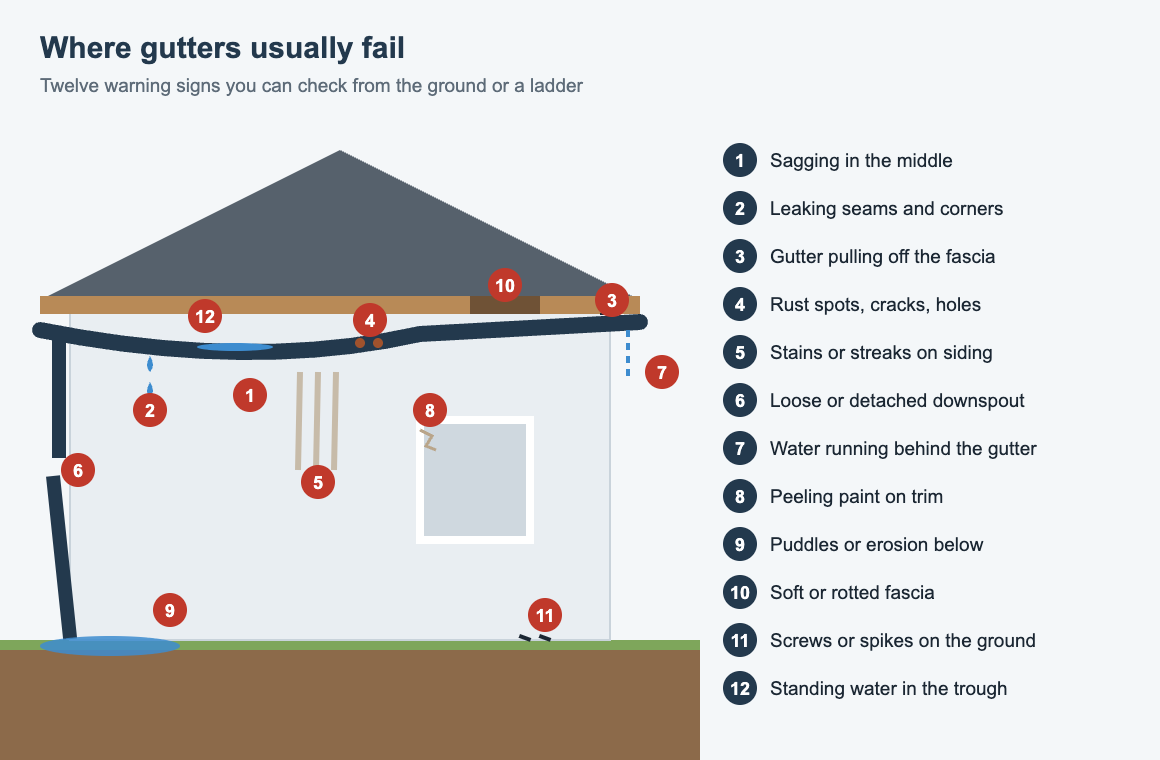
Signs you can see from the ground
Start with a slow walk around the house, ideally during a steady rain or within an hour after it stops. Look up at the gutter line, then down at the walls and the ground under it.
1. Sagging gutters
A gutter should run in a straight, slightly sloped line. If one section dips in the middle or hangs lower at one end, the hangers holding it are loose, bent or spaced too far apart. You will see a wave in the gutter line, water spilling over at the low point, and sometimes gaps opening at nearby seams. Snow and ice make it worse every winter, since a sagging gutter holds more water, which freezes and adds weight.
2. Leaks at seams and corners
Sectional gutters are joined every 10 feet or so, and every joint is sealed with caulk that dries out and cracks over time. Seamless gutters only have joints at corners, end caps and downspout outlets, but those spots leak too. If water drips from the same spot every time it rains, the seal there has failed. Left alone, the drip stains the siding and soaks the soil right under it.
3. Gutters pulling away from the house
A gap between the back of the gutter and the fascia board is one of the more serious signs. It usually means the fasteners have pulled out of the wood, often because the wood behind them has started to rot. Water then runs between the gutter and the house instead of into the trough. If this happens after a storm, have it checked quickly. A loose section can drop or tear off more of the fascia in the next wind.
4. Stains and streaks on the siding
Dark streaks, white mineral lines or rust colored stains running down the siding under the gutter show where water has been spilling over or leaking for a while. They are easy to spot on light siding and painted trim.
5. Puddles, erosion and wet basements
Washed out mulch, bare soil, small trenches along the drip line or puddles near the foundation mean water is landing next to the house. InterNACHI inspection guidance says downspouts should direct water 4 to 6 feet away from the foundation. If the ground under the gutters is soaked after every rain, the gutters are leaking, overflowing or emptying too close to the wall. A damp basement after heavy rain is often the end result. Downspout extensions or an underground drain line carry the water farther out. How far is enough is covered in how gutters protect your foundation.
6. Loose or detached downspouts
Downspouts are held to the wall with straps and joined at elbows. When a strap breaks or an elbow separates, the downspout leans away from the house or dumps water at the joint. Look for downspouts that move when you push on them, gaps at elbows and outlets that end right at the foundation.
Signs you find up close
The next six signs are easier to confirm from a ladder. If you are not comfortable working at height, a professional inspection covers all of them in one visit.
7. Water running behind the gutter
Sometimes water drips from behind the gutter even though the trough is clear and no seam is leaking. The usual cause is a gap between the roof edge and the gutter, so water rolls off the shingles and down the fascia. A missing or short drip edge, or a gutter mounted too low on the fascia, causes the same thing. Over time it rots the fascia and soffit, and it can reach the roof sheathing, as explained in can clogged gutters cause roof damage.
8. Peeling paint and wet trim
Paint that peels or bubbles on the fascia, soffit or window trim near the gutter line is a sign the wood stays wet. It is often the first visible clue of a hidden leak or water running behind the gutter.
9. Rust, cracks and holes
Steel gutters rust first inside the trough, especially where leaves and water sit for weeks. Aluminum does not rust, but it can crack or split at seams, and thin aluminum dents easily under ladders and falling branches. Check the bottom of the trough and the area around outlets. A small hole can sometimes be patched, but spots of rust along a long run usually mean the metal is near the end of its life.
10. Soft or rotted fascia
Press on the fascia board behind the gutter with a screwdriver. If it feels soft, crumbles or the tip sinks in, the wood is rotting. Gutters cannot hold their fasteners in soft wood, so the fascia has to be repaired before the gutter can be secured properly.
11. Fasteners on the ground
Screws, spikes or hanger pieces lying in the flower beds or on the driveway under the roof line came from your gutters. Older gutters are often held with long spikes driven through the gutter into the fascia, and those spikes back out as the wood expands and shrinks with the seasons. Modern hidden hangers fastened with screws hold much better.
12. Standing water in the trough
A gutter should drain within a short time after rain stops. If water sits in a section for days, the pitch is wrong or the gutter has sagged into a low spot. InterNACHI cites a common standard of about 1/16 inch of fall per foot toward the downspout. Standing water breeds mosquitoes, adds weight and freezes into a block of ice in winter.
Clogged, broken or badly pitched?
Many homeowners are not sure whether their gutter is broken or just clogged. The way water behaves during a steady rain usually answers it.
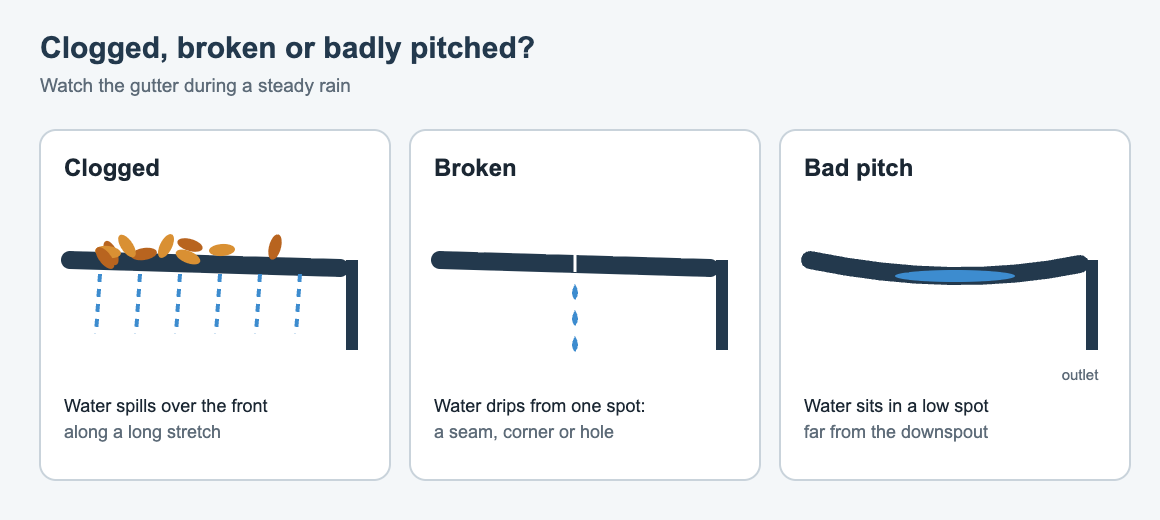
- Clogged: water spills over the front edge along a long stretch, often worst near the downspout outlet. Cleaning fixes it, and regular gutter cleaning keeps it from coming back.
- Broken: water drips from one spot, such as a seam, a corner, a hole or the joint at a downspout. Cleaning does not help. The joint needs resealing or the section needs replacing.
- Badly pitched: water collects in the middle of a run and does not reach the outlet. The hangers need adjusting so the gutter falls toward the downspout again.
If it is not raining, you can run the test with a garden hose. This is how we usually check a gutter on a dry day:
- Clear the trough first. Remove leaves and grit by hand so a clog does not hide a leak.
- Run water at the far end. Lay the hose in the gutter at the end farthest from the downspout and let it run at a moderate flow.
- Watch the flow. Water should move steadily toward the outlet. If it pools or runs the wrong way, the pitch is off.
- Check every joint from below. Drips at seams, corners or end caps mark the spots that need sealing.
- Check the downspout. Water should come out the bottom at full flow. A trickle or water backing up at the top means the downspout or an elbow is blocked.
Repair or replace: quick check
Many gutters can be repaired for years of extra service. Others cost more to keep patching than to replace. Answer six questions for a rough idea of where yours stand.
Repair or replace check
Six questions about your gutters. Your answers stay in your browser.
Lifespan figures come from InterNACHI’s life expectancy chart for homes. Real life varies with installation and care.
| Situation | Usually repair | Usually replace |
|---|---|---|
| Leaks | One or a few leaking seams or corners | Leaks at many joints along every run |
| Sagging | A section sags because hangers are loose | Gutters bent or kinked along long stretches |
| Rust and holes | A small hole or a single rusty spot | Rust through the bottom in several places |
| Fascia | A short piece of rotted fascia | Rot along most of the roof edge |
| Age | Aluminum gutters in the first half of their life | Steel gutters around 20 years old, or aluminum near the end of its 20 to 40 year range |
| Capacity | Gutters handle rain except for one clogged outlet | Gutters overflow in heavy rain even when clean |
If replacement makes more sense, our gutter installation service puts up seamless gutters, which have no joints along the straight runs where older sectional systems tend to leak. If you are choosing a material, see how seamless gutters compare and copper vs. aluminum lifespans.
What gutter repair usually involves
Can house gutters be repaired? In most cases, yes. These are the repairs we do most often:
- Resealing leaking seams, corners and end caps with gutter sealant after cleaning and drying the joint.
- Replacing old spikes with hidden hangers and screws, and adding hangers where they are spaced too far apart.
- Re-pitching sagging sections so water flows to the downspout.
- Replacing a damaged section of gutter, an end cap or a downspout outlet.
- Reattaching downspouts, replacing broken straps and elbows, and adding extensions.
- Replacing short pieces of rotted fascia before the gutter is rehung.
- Installing a drip edge or gutter apron where water runs behind the gutter.
The cost of gutter repair depends on the type of repair, the height and length of the gutters, how many sections are affected and whether the fascia behind them needs work. We do not quote a price before seeing the house, so we inspect it and give you a free estimate. Our gutter repair service covers Stamford, Greenwich, Norwalk and the rest of Fairfield County, plus nearby Westchester.
Caulk from the hardware store can slow a small drip, but it rarely lasts long on a dirty or wet joint, and it does nothing for sagging, rot or a bad pitch. If a problem keeps coming back after a quick patch, the cause is usually underneath it.
Does homeowners insurance cover gutter damage?
It depends on the cause. According to Progressive, gutters damaged by a covered peril such as a windstorm or a falling tree limb may be covered under dwelling coverage, subject to your limits and deductible. Damage from wear and tear or neglect generally is not, and gutters that were loose and poorly secured before a storm may not be covered either. The Insurance Information Institute describes standard homeowners policies the same way: they cover sudden damage, not maintenance.
If your gutters pulled away from the fascia after a storm, take photos before anything is moved and check your policy. Keeping a record of regular cleaning and repairs also helps show the damage was not from neglect.
Why gutters wear out faster in Connecticut
Snow and ice sit in the trough for weeks and add weight to every hanger (more on that in winter gutter problems in Connecticut). Repeated freezing and thawing opens seams and pushes fasteners out of the wood. Oaks and maples fill gutters every fall, and wet leaves hold water against the metal. Near the shoreline, salt air speeds up corrosion. We suggest checking the gutters every spring after the snow melts and again in the fall, along with cleaning at least twice a year.
Common mistakes
| Mistake | Consequence |
|---|---|
| Caulking over a dirty, wet seam | The patch peels off within weeks and the leak returns |
| Hammering loose spikes back in | They back out again, and each hole weakens the fascia |
| Ignoring a small sag | Ice and debris collect at the low spot and the sag grows each winter |
| Rehanging gutters on soft fascia | New fasteners pull out of the rotted wood |
| Leaning a ladder on the gutter | Dents and bends the trough and loosens hangers |
| Treating every overflow as a clog | Bad pitch or undersized gutters go unfixed |
Gutter guards cut down on the debris that causes many of these problems. If you have heavy tree cover, our gutter guard installation keeps most leaves out, though guards still need an occasional check.
FAQ
What are the most common signs of gutter damage?
The most common signs are sagging sections, drips at seams and corners, gutters pulling away from the fascia, rust or holes, stains on the siding below and puddles or erosion along the foundation.
How do I know if my gutter is broken or just clogged?
Watch it in a steady rain. A clogged gutter spills water over the front along a long stretch. A broken gutter drips from one spot, such as a seam, corner or hole. If water sits in the middle of a run and never reaches the downspout, the pitch is wrong.
Can house gutters be repaired?
Most gutter problems can be repaired. Leaking seams can be resealed, sagging sections rehung and re-pitched, and damaged pieces or downspouts replaced. Replacement makes more sense when rust, leaks or rotted fascia run along most of the system.
Do I need new gutters or just a repair?
One or a few problem spots on gutters that are otherwise sound usually call for repair. Older gutters with rust in several places, many leaking joints or rotted fascia along long runs are usually better replaced.
Why is water dripping from my gutter when it is not raining?
Usually water is still draining from a clog or a low spot where the gutter has sagged. In winter it can be snow melting on the roof. If the drip comes from behind the gutter, water may be running down the fascia because of a gap at the roof edge.
Is gutter damage covered by homeowners insurance?
Gutters damaged by a covered event such as a windstorm or falling tree limb may be covered, subject to your deductible. Damage from age, wear and tear or neglect generally is not. Check your own policy for the exact terms.
How much does it cost to repair gutters?
Cost depends on the type of repair, the height and length of the gutters, how many sections are affected and whether the fascia needs work. We inspect the house and give a free estimate before any work starts.
Not sure what your gutters need?
We inspect, repair and replace gutters across Stamford, Fairfield County and Westchester, and tell you plainly whether a repair will do. Estimates are free, and pricing depends on your house, so call or send the form for yours.
Call (203) 399-2793
Related articles