How a Proper Gutter System Protects Your Foundation
A roof collects a surprising amount of water. Every inch of rain on an average house adds up to hundreds of gallons, and all of it lands within a few feet of the foundation unless the gutters and downspouts carry it away.
Short answer
- Gutters collect roof water and send it through downspouts away from the house, so it does not soak the soil along the foundation.
- One inch of rain on 1,000 square feet of roof is about 623 gallons of water.
- Downspouts should discharge several feet from the foundation. Home inspectors commonly look for 4 to 6 feet, and the building code calls for at least 5 feet in some soil conditions.
- The ground should slope away from the house. The residential code calls for a 6 inch drop within the first 10 feet.
- Clogged gutters and short downspouts are a common cause of wet basements and can add to foundation cracking.
In this article
How much water a roof sheds
According to the US Geological Survey, one inch of rain over one acre is 27,154 gallons. Scaled down to a house, that works out to about 0.62 gallons per square foot of roof for every inch of rain, or roughly 623 gallons per 1,000 square feet.
| Roof area | 0.5 inch of rain | 1 inch of rain | 2 inches of rain |
|---|---|---|---|
| 1,000 sq ft | about 310 gal | about 620 gal | about 1,250 gal |
| 1,500 sq ft | about 470 gal | about 930 gal | about 1,870 gal |
| 2,000 sq ft | about 620 gal | about 1,250 gal | about 2,490 gal |
| 3,000 sq ft | about 930 gal | about 1,870 gal | about 3,740 gal |
Calculated from the USGS figure of 27,154 gallons per acre per inch. Use the roof’s footprint, not the sloped surface area.
Split between four or five downspouts, that is a lot of water per outlet. If each one empties right next to the wall, the soil there gets the runoff from hundreds of square feet of roof in a single storm.
Roof runoff calculator
Enter your roof’s footprint, pick a storm size and the number of downspouts. The calculator shows how much water each downspout has to move away from your house.
Roof runoff calculator
Use the roof footprint (the area of the house from above, including overhangs).
How gutters protect the foundation
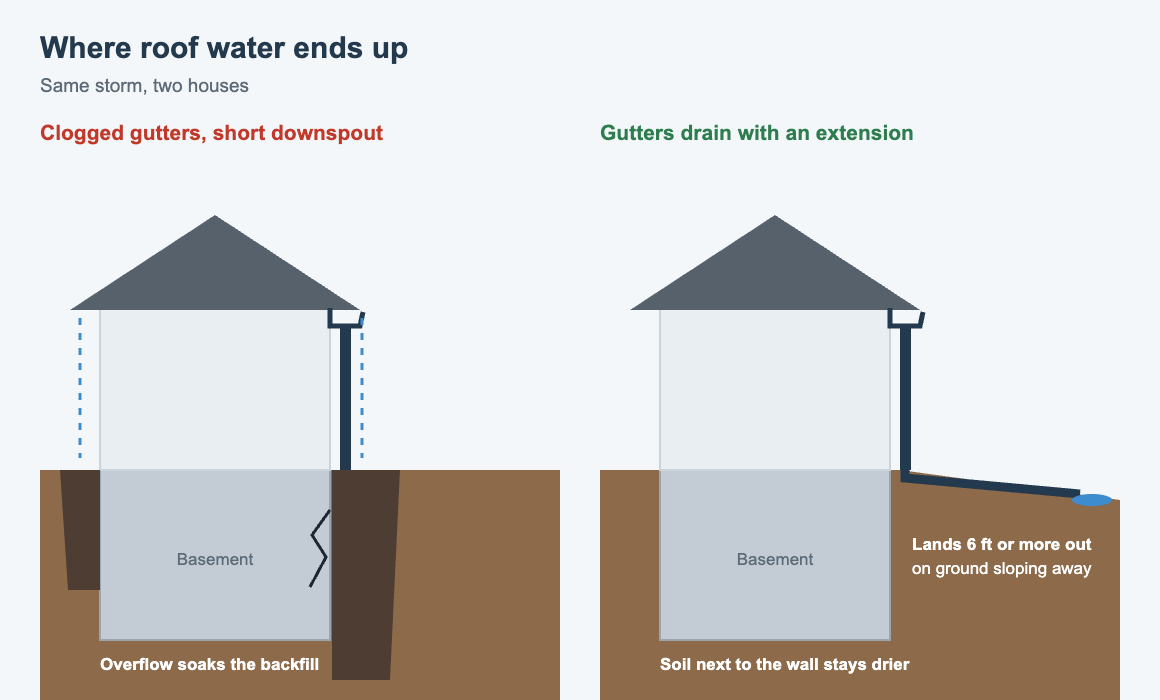
Dry backfill
The soil right around a foundation was dug out and backfilled when the house was built, so it is looser than undisturbed ground and takes on water easily. Water dumped there soaks down along the wall. Saturated soil presses against the foundation, and that water looks for any crack, tie hole or joint to get through. A gutter system that drains properly keeps most roof water out of that zone.
Less frost movement
Wet soil near the surface freezes and expands in winter, then softens in a thaw. Repeated cycles push on walls, crack walkways and settle steps. Drier soil next to the house moves much less.
No erosion along the drip line
Water pouring off a roof edge without a gutter digs a trench along the drip line, washes out mulch and can expose the top of the foundation. Over the years that changes the grade around the house, often so it slopes toward the wall instead of away from it.
A drier basement
Many wet basements trace back to surface water collecting next to the house rather than to high groundwater. Clean gutters and well placed downspouts are usually the first and cheapest fix to try.
How far downspouts should drain
Most guidance falls in a narrow range:
- InterNACHI’s inspection guide tells inspectors to check that downspouts divert water 4 to 6 feet away from the foundation.
- The International Residential Code, section R801.3, requires roof drainage to discharge at least 5 feet from foundation walls, or into an approved drainage system, where expansive or collapsible soils are known to exist.
- Many contractors suggest going farther on heavy clay soil or where the yard is flat, since water spreads slowly in those conditions.
Grading matters as much as distance. Section R401.3 of the residential code calls for the ground to fall at least 6 inches within the first 10 feet from the foundation. If a downspout empties 6 feet out onto ground that slopes back toward the house, the water just runs back to the wall.
| Item | Common target | Source |
|---|---|---|
| Downspout discharge | 4 to 6 feet from the foundation | InterNACHI inspection guide |
| Discharge in expansive or collapsible soils | At least 5 feet, or to an approved drainage system | IRC R801.3 |
| Ground slope away from the house | 6 inches of fall in the first 10 feet | IRC R401.3 |
| Gutter pitch toward downspouts | About 1/16 inch per foot | InterNACHI |
| Downspout spacing | Roughly one per 30 to 40 feet of gutter | Common industry rule of thumb |
Splash blocks, extensions or underground drainage
| Option | Good for | Drawbacks |
|---|---|---|
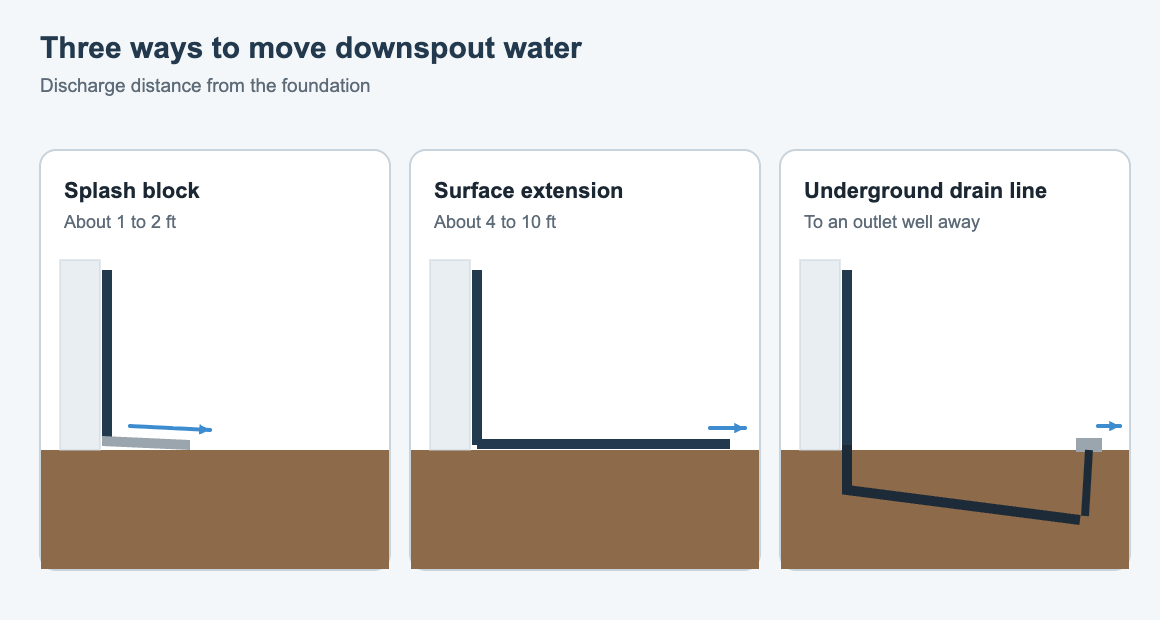
| Splash block | Spreading water where the ground already slopes away | Moves water only a foot or two |
| Above ground extension | Getting water 4 to 10 feet out cheaply | In the way of mowing and walking, easy to knock off |
| Flip up or roll out extension | Spots next to walkways and driveways | Has to be put back down after it is moved |
| Underground drain line | Carrying water well away from the house, out of sight | Needs proper slope and an outlet, and must stay clear |
Underground lines are the cleanest long term option when the yard allows it, and they can qualify as the approved drainage system the code mentions. Our underground drainage installation connects downspouts to buried pipe that carries water away from the foundation. If an existing buried line backs up, it is usually clogged with debris that washed down from the gutters.
Signs your gutters are failing the foundation
- Puddles along the house or at the corners after rain
- A trench or bare soil under the roof edge
- Water spilling over the gutters during moderate rain
- Downspouts that end right at the wall, or extensions that have come off
- Damp spots, efflorescence (white mineral deposits) or a musty smell in the basement
- New cracks in basement walls, steps or walks next to the house
- Sheets of ice on walkways under the gutters in winter
Walk around the house during a steady rain with an umbrella. It is the fastest way to see where water actually goes.
Common mistakes
| Mistake | Consequence |
|---|---|
| Letting gutters clog | Overflow lands along the whole wall, not just at downspouts |
| Downspouts ending at the wall | Concentrated runoff soaks the backfill |
| Grade sloping toward the house | Discharged water flows right back |
| Too few downspouts on a long run | Gutters overflow in heavy rain even when clean |
| Buried lines with no clean out or outlet | Lines clog and back up into the downspout |
| Mulch beds piled against siding | Holds moisture against the wall and hides grade problems |
Our gutter cleaning service clears every run by hand and flushes each downspout, and most homes need it at least twice a year. If gutters are undersized or sagging, gutter repair or new seamless gutters may be the better fix.
FAQ
Do gutters really protect the foundation?
Without gutters, roof water falls along the whole perimeter of the house and soaks the backfill next to the foundation. A working gutter system collects that water and releases it at a few points away from the walls.
How far should downspouts drain from the house?
Home inspectors commonly look for 4 to 6 feet. The International Residential Code calls for at least 5 feet, or discharge into an approved drainage system, where expansive or collapsible soils exist. Flat yards and clay soil benefit from going farther.
Is a splash block enough?
Only where the ground already slopes clearly away from the house. A splash block moves water a foot or two, which is often not enough to keep it off the backfill.
Can clogged gutters cause foundation problems?
Clogged gutters overflow along their whole length, so water lands next to the wall in many places instead of at the downspouts. Over time that leads to wet basements, erosion and cracks.
How much should the ground slope away from the house?
The residential code calls for the grade to fall at least 6 inches within the first 10 feet from the foundation.
Are underground downspout drains worth it?
They are the cleanest way to carry water well away from the house, and they stay out of the way of mowing and walking. They need proper slope and an outlet, and they work best when the gutters feeding them are kept clean.
How many downspouts does a house need?
A common rule of thumb is one downspout for every 30 to 40 feet of gutter, with more on steep or large roofs. If gutters overflow in heavy rain even when clean, you may need more downspouts or larger gutters.
Get the water away from your foundation
We clean and repair gutters and install underground drainage for downspouts across Stamford and Fairfield County. Estimates are free, and pricing depends on your property, so call or send the form for yours.
Call (203) 399-2793
Related articles