Can Clogged Gutters Cause Roof Damage?
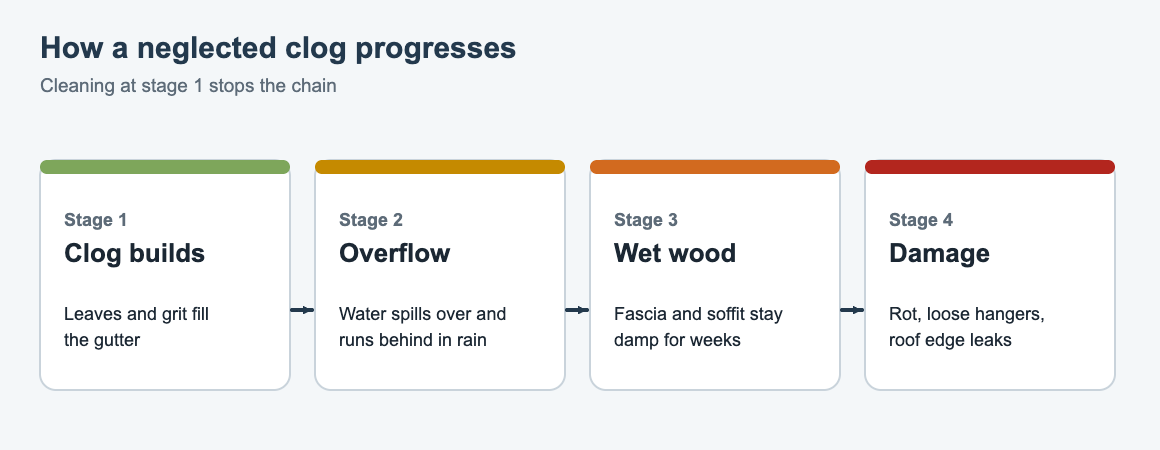
Yes, clogged gutters can damage a roof. It happens slowly, over seasons, rather than in one storm. Water that cannot get into the gutter backs up at the roof edge, soaks the wood the roof is built on and, in winter, freezes into ice that pushes under the shingles.
Below we walk through how that happens, which parts of the roof get hurt first, the signs you can see from the ground, and why insurance often won’t cover it.
Short answer
- Clogged gutters damage the roof edge first: the fascia board, the drip edge and the first few feet of roof sheathing.
- Overflowing water runs behind the gutter, soaks the wood and can back up under the lowest row of shingles.
- In winter, a clogged gutter fills with ice and makes ice dam leaks worse.
- Wet debris is heavy. It strains hangers and pulls gutters away from the fascia, which lets even more water behind.
- Insurers generally treat damage from poor maintenance as the homeowner’s responsibility, so a record of regular cleaning matters.
In this article
How clogged gutters damage a roof
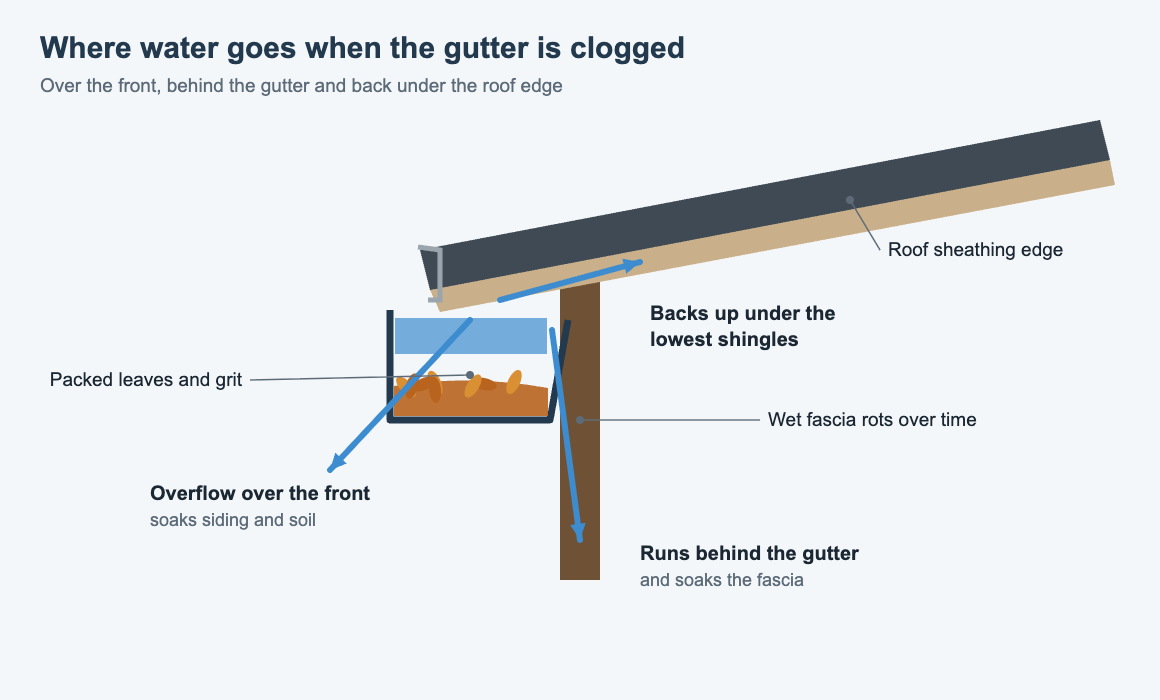
Rain runs down the shingles, over a metal strip called the drip edge, and into the gutter. When the gutter is packed with leaves, pine needles and shingle grit, the water goes one of three places.
Water runs behind the gutter
A full gutter overflows at its lowest point, and some of that water runs back toward the house instead of over the front lip. It goes behind the gutter, down the face of the fascia board and into the soffit. The drip edge exists to keep water off that wood, but it can only do its job if the gutter below it is draining. When water ends up behind the gutter for weeks at a time, the wood stays wet.
Water backs up under the shingles
In a heavy rain, a gutter that is full to the brim can hold water against the bottom edge of the roof. Shingles are made to shed water moving downhill. They are not built to hold back standing water, which can seep under the starter course and reach the roof sheathing beneath.
Ice makes it worse
Clogged gutters do not cause ice dams on their own. The University of Minnesota Extension and other building science sources trace ice dams to heat escaping into the attic. But a gutter full of frozen debris gives that ice a solid base right at the edge, so the dam grows heavier and the water behind it has even fewer ways out. When the dam holds water, it works its way under the shingles and into the attic. More on that in why ice dams form.
Which parts of the roof get hurt
| Part | What it does | How clogs damage it |
|---|---|---|
| Fascia board | The board along the roof edge that the gutter is fastened to | Stays wet, softens and rots; hangers loosen |
| Soffit | The underside of the roof overhang | Water stains, rot, openings for birds and insects |
| Drip edge | Metal strip that guides water into the gutter | Water bypasses it when the gutter backs up |
| Roof sheathing | The plywood or boards under the shingles | Edge of the deck absorbs water and starts to rot |
| Shingles | The roof covering | Lower rows lift or deteriorate; ice pushes water under them |
| Attic and ceilings | Living space below the roof | Leaks show as stains near exterior walls |
The weight of the debris adds to all of this. Water weighs about 8.3 pounds per gallon, according to the US Geological Survey, and a gutter full of soaked leaves holds a lot of it along with the debris itself. That load pulls on every hanger. Once a gutter tips away from the fascia, water pours straight down the gap behind it, and the damage speeds up.
Signs clogged gutters are already causing damage
- Water spilling over the gutter in moderate rain, especially at corners
- Plants, moss or seedlings growing in the gutter
- A gutter that tilts forward or pulls away from the house
- Peeling paint, dark stains or soft spots on the fascia
- Stains or streaks on the soffit and siding below the gutter line
- Brown ceiling stains near the outside walls on the top floor
- Large icicles and thick ice at the eaves in winter
- Washed out mulch or a trench in the soil under the drip line
If you see two or more of these, the clog has probably been there for a while, and the gutter itself may need work too: sagging runs and open seams are among the signs your gutters need repair.
Symptom checker
Tell us what you are seeing, and the checker will estimate how urgent the problem is.
Clogged gutter symptom checker
Pick what you can see from the ground.
Insurance and roof warranties
The Insurance Information Institute notes that standard homeowners policies do not cover poor maintenance, and that most maintenance related problems are the homeowner’s responsibility. Insurers generally pay for sudden, accidental damage, not damage that built up gradually. A leak traced to gutters that have not been cleaned in years can fall on the wrong side of that line.
Shingle warranties have their own limits. GAF, one of the largest shingle makers in the US, states in a technical bulletin that its limited warranty does not cover the installation or performance of the gutter and drainage system, and that granule loss caused by water discharged from gutters and downspouts onto lower roof surfaces is not its responsibility.
Keep a cleaning record and a few photos of your gutters. They are the simplest proof that the house has been maintained.
How to prevent roof damage from gutters
- Clean at least twice a year. Late spring and late fall cover most homes. Houses under oaks, maples or pines often need three or four cleanings a year.
- Clear the downspouts too. A clean gutter that drains into a packed elbow still overflows. Each downspout should be flushed.
- Clear debris from the roof edge and valleys. Leaves sitting on the lower roof wash into the gutter with the next rain.
- Fix pitch and loose hangers. Water should run toward the downspouts without sitting in the corners. Loose hangers and soft fascia are repair jobs, not cleaning jobs; see our gutter repair service.
- Consider gutter guards under heavy trees. Guards cut down on debris, though pine needles and seed pods still need occasional clearing. Our gutter guard installation uses the MicroGuard mesh system.
- Check the roof edge after big storms. A quick look from the ground for sagging gutters and new stains catches problems early.
| Mistake | Consequence |
|---|---|
| Cleaning only in spring | Fall leaves sit in the gutter all winter and freeze |
| Ignoring a small overflow at one corner | That corner of the fascia rots first |
| Pressure washing debris down the downspout | Packs the elbow tighter |
| Leaning a ladder on a full gutter | Bends the gutter and loosens hangers |
| Replacing shingles without fixing the gutters | The new roof edge gets wet the same way |
If your gutters are overflowing already, our gutter cleaning service clears every run by hand, flushes the downspouts and removes loose debris from the roof edge right above the gutters. Overflow also reaches the siding and foundation, covered in how gutters protect your foundation.
FAQ
Can clogged gutters cause roof leaks?
A full gutter can hold water against the lowest row of shingles, and overflow runs behind the gutter into the fascia and roof sheathing. In winter, clogged gutters also make ice dam leaks worse.
How long does it take for clogged gutters to damage a roof?
There is no fixed timeline. Damage builds over seasons of repeated soaking. A gutter that stays clogged through a fall, winter and spring gives wood a long time to stay wet, which is why regular cleaning matters.
Can clogged gutters cause ceiling leaks?
They can. Water that backs up under the shingles or behind an ice dam can reach the attic and show up as stains near the outside walls of the top floor.
Will insurance cover roof damage from clogged gutters?
Standard homeowners policies generally exclude damage from poor maintenance and gradual deterioration. Keeping a record of gutter cleaning helps show the house was maintained.
What is fascia rot?
Fascia is the board along the roof edge that the gutter is fastened to. When water runs behind a clogged gutter for long periods, the board stays wet and rots, and it can no longer hold the gutter securely.
How often should gutters be cleaned to protect the roof?
At least twice a year, in late spring and late fall. Homes under heavy tree cover often need three or four cleanings a year.
Keep water off your roof edge
We clean gutters by hand, flush every downspout and tell you if we see loose hangers or leaking seams. Estimates are free, and pricing depends on your house, so call or send the form for yours.
Call (203) 399-2793
Related articles