The Most Common Winter Gutter Problems in Connecticut
Most gutter trouble in Connecticut starts in the fall and shows up in winter. Leaves left in the gutters in November turn into a wet, heavy mat, the mat freezes, and the next snow sits on top of it. By January the gutter is carrying weight it was never built for, and water that should be leaving the roof has nowhere to go.
Below are the winter gutter problems that turn up most around Stamford and Fairfield County, how to spot each one from the ground, and what prevents them.
Short answer
- The most common winter gutter problems in Connecticut are frozen gutters and downspouts, ice dams at the roof edge, sagging or detached sections, leaking seams and water spilling next to the foundation.
- Almost all of them get worse when gutters go into winter with leaves still inside.
- Coastal Connecticut swings above and below freezing many times a winter, which is hard on joints, seams and fasteners.
- Gutters do not cause ice dams. Heat escaping into the attic does. Clogged gutters make the ice heavier and the damage worse.
- A cleaning after the last leaves fall, secure hangers and downspouts that drain away from the house cover most of the risk.
In this article
Why winter is hard on gutters in Connecticut
Connecticut does not get the heaviest snow in New England, but it gets a difficult mix. According to NOAA’s state climate summary, seasonal snowfall runs from about 30 to 35 inches along the coast to around 50 inches in the Northwest Hills. Along the shoreline, the bigger issue is temperature. At Bridgeport, the closest long-term weather station to Stamford, normal January highs sit near 38°F and normal lows near 24°F. That means many days thaw in the afternoon and freeze again at night.
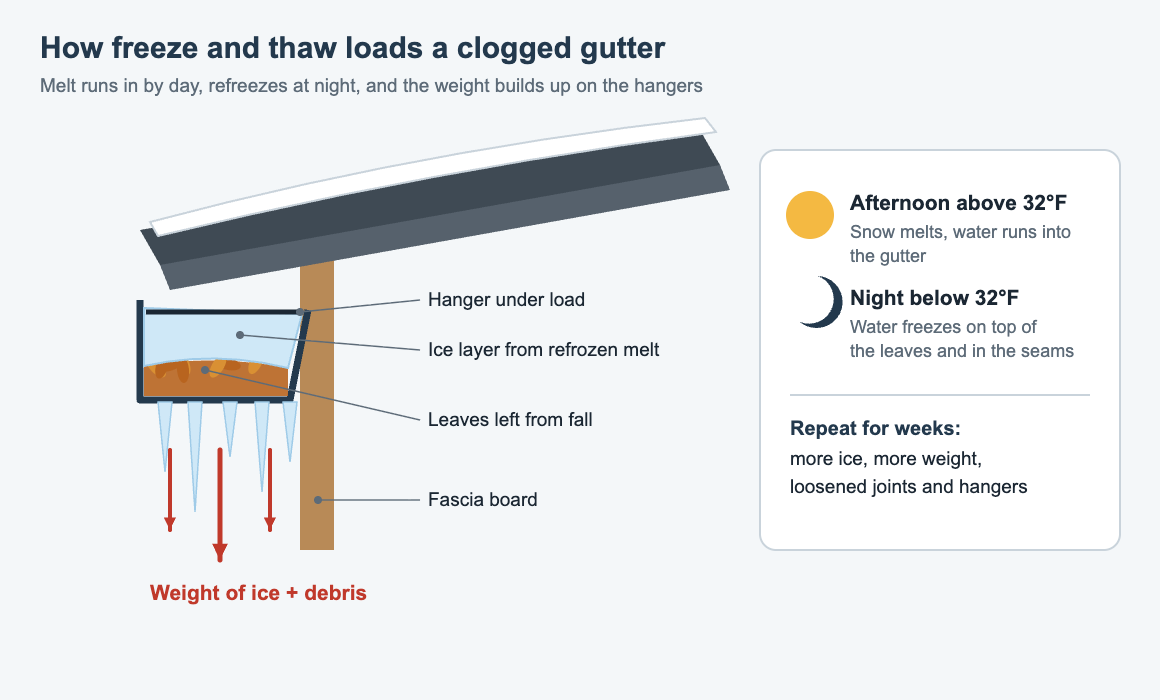
Every one of those cycles does the same thing to a gutter. Snow on the roof melts, runs into the gutter, and freezes again after dark. Water that got into a seam or behind a hanger expands as it freezes, which slowly pushes joints apart and loosens fasteners. Over a winter, a gutter that looked fine in October can end up leaking at every corner.
| Month | Normal high | Normal low | Normal snowfall |
|---|---|---|---|
| December | 43.8°F | 30.2°F | 5.5 in |
| January | 38.4°F | 24.4°F | 8.5 in |
| February | 40.5°F | 25.7°F | 10.7 in |
Source: National Weather Service climate almanacs for Bridgeport.
Inland towns such as Danbury and Ridgefield are farther from the moderating effect of Long Island Sound and usually see colder nights.
Weight is the other factor. FEMA’s snow load guide puts one foot of light, dry snow at about 3 pounds per square foot and one foot of wet, heavy snow at up to 21 pounds. One inch of ice weighs a little under 5 pounds per square foot. A gutter packed with frozen leaves and topped with ice is carrying a lot of that load on a few hangers.
The 7 most common winter gutter problems
1. Frozen gutters
Some ice in a gutter on a cold morning is normal. A gutter that stays frozen solid for days is not. It usually means water could not drain before the temperature dropped, most often because leaves, pine needles or shingle grit were still sitting in the trough. Once the gutter is full of ice, every new melt has to go over the front edge or behind the gutter.
2. Frozen or blocked downspouts
Downspouts freeze from the bottom up. If the outlet at the ground is buried in snow or the elbow is packed with leaves, water backs up inside the pipe and freezes there. The gutter above then fills up and overflows. A downspout that drips at the seams or has split vertically is a sign it froze full.
3. Ice dams at the roof edge
Ice dams are ridges of ice along the eaves that hold back melting snow. Water pools behind the dam and can work its way under shingles and into the attic or walls. Building science sources, including InterNACHI and Building Science Corporation, agree that gutters do not cause ice dams. They form when heat from the house warms the upper roof above 32°F while the edge stays below freezing. Clogged gutters still make things worse, because they give the ice a place to build and add weight right at the edge. The full mechanism is explained in why ice dams form and how gutters help.
4. Sagging and detached gutters
Ice is heavy, and it collects at the lowest point of a run. Hangers that were spaced too far apart, screwed into soft fascia, or simply loosened by years of freeze and thaw start to bend. The gutter tips forward, water stops reaching the downspout, and in bad cases a whole section pulls off the house. Sagging is easiest to see from the street on a sunny day after a storm, when you can follow the line of the gutter against the roof.
5. Leaking seams, corners and end caps
Sectional gutters have a joint every 10 feet or so, and each joint relies on sealant. Freezing water expands inside small gaps and slowly opens them. You will usually notice it in spring as drips at the corners, stains on siding below the joints, or a line of washed out mulch. Seamless gutters avoid most of this, because they only have seams at the corners and downspout outlets.
6. Water at the foundation
When the gutter or downspout is frozen, melting snow comes straight off the roof and lands next to the house. In a thaw it soaks the soil along the foundation. When it freezes again, the wet soil expands. Connecticut building rules have long used 42 inches as the frost depth for footings, which tells you how deep the ground can freeze here. Repeated soaking and freezing near the walls is a common route to damp basements and cracked walks, which is why downspouts need to drain away from the foundation.
7. Damaged fascia and soffits
Water that runs behind a frozen gutter soaks the fascia board it is fastened to. Wood that stays wet through a winter softens and rots, and soft fascia cannot hold hangers. Peeling paint, dark stains on the fascia and gaps between the gutter and the board are the early signs.
| Problem | What you see from the ground | Main cause |
|---|---|---|
| Frozen gutter | Ice spilling over the front edge, large icicles | Debris left in the gutter, poor pitch |
| Frozen downspout | No water at the outlet in a thaw, split seams | Packed elbows, buried outlet |
| Ice dam | Thick ridge of ice at the eaves, ceiling stains | Heat loss into the attic |
| Sagging section | Wavy gutter line, gutter tilted forward | Ice weight, loose or widely spaced hangers |
| Leaking seams | Drips at corners, streaks on siding | Freeze and thaw opening joints |
| Foundation water | Ice sheets on walks, damp basement | Overflow and short downspouts |
| Fascia damage | Peeling paint, gaps behind the gutter | Water running behind the gutter |
Check your gutters before winter
The quick check below takes a minute. Answer each question for your house, and it will tell you how exposed your gutters are going into the cold season.
Winter readiness check
Six questions about your gutters. Your answers stay in your browser.
How to prevent winter gutter damage
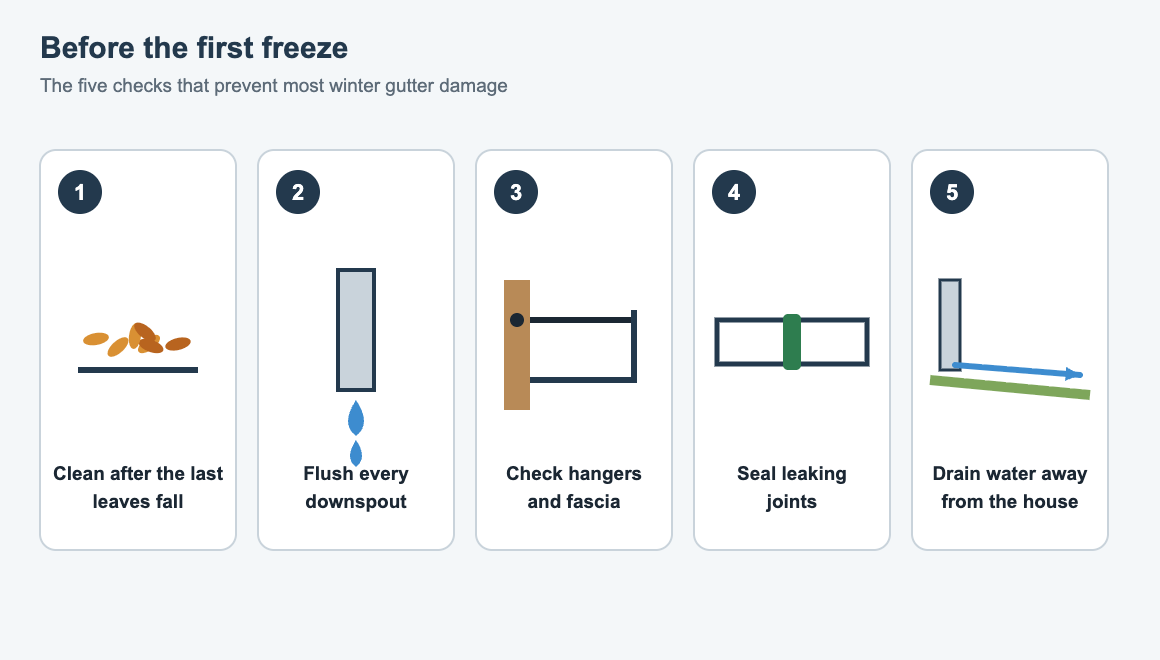
- Clean after the last leaves fall. In most of Fairfield County that means late November or early December. A cleaning in October often misses the oaks, which hold their leaves longest, so time the cleaning after the oaks drop. Our gutter cleaning service includes flushing every downspout.
- Flush the downspouts. A gutter can look clear and still drain into a packed elbow. Running water through each downspout before winter is the only way to know it is open.
- Tighten or add hangers. Common practice is a hanger every 24 to 36 inches, and many installers go closer in areas with heavy snow and ice. Loose hangers and soft fascia should be dealt with before the first storm, not after a section falls. Our gutter repair team handles resecuring and replacing damaged sections.
- Seal leaking joints. Small drips in the fall become open seams by spring. Resealing corners and end caps while the weather is still mild works better than trying it in the cold.
- Move water away from the house. Downspout extensions or an underground drainage line keep melt from soaking the soil along the foundation. Keep outlets clear of piled snow.
- Look at the attic, not only the gutters. If you had ice dams last winter, the fix is air sealing and insulation in the attic. Gutters can be perfect and the house will still form ice dams if heat is escaping.
- Consider gutter guards for heavy tree cover. Guards keep most leaves out, so less debris freezes in place, though gutter guards still need occasional clearing. We install the MicroGuard mesh system through our gutter guard service.
Winter gutter mistakes to avoid
| Mistake | What happens |
|---|---|
| Skipping the late fall cleaning | Leaves freeze in place, the gutter overflows all winter |
| Chipping ice out with a hammer or shovel | Dented gutters, torn shingles, broken hangers |
| Using rock salt in gutters | Corrodes metal and can damage plants below |
| Hanging on gutters or leaning a ladder on them in the cold | Bent sections and loosened fasteners |
| Letting snow bury the downspout outlets | Downspouts freeze from the bottom and back up |
| Relying on heat cable alone for ice dams | Small melt channels while the ice dam keeps growing |
If ice has already formed, the safest choices are patience and a roof rake used from the ground for the first few feet of snow at the eaves. Never climb an icy ladder to work on a frozen gutter. Damage you find after a storm, such as a bent or loose section, can be repaired once conditions are safe.
FAQ
Is it normal for gutters to freeze in winter?
A thin layer of ice on a cold morning is normal. A gutter that stays frozen solid for days usually could not drain before the freeze, most often because of leaves or a blocked downspout.
Should I knock icicles off my gutters?
Small icicles can be knocked down from the ground with a broom if nobody stands underneath. Do not hit large icicles or ice dams with tools, because that bends gutters and tears shingles. Large icicles are often a sign of heat loss into the attic.
Do gutters cause ice dams?
Ice dams form when heat escaping from the house warms the upper roof while the eaves stay below freezing. Gutters give the ice a place to collect, so clogged or loose gutters make the damage worse, but they are not the cause.
Should I take my gutters down for the winter?
Leave them up. Without gutters, melting snow lands right next to the foundation all winter, so keep them clean and securely fastened instead.
Can gutters be cleaned in winter?
Gutters can be cleaned on dry days above freezing when there is no ice on the roof edge. The best time is late fall, after the last leaves come down and before the first hard freeze.
Do heat cables keep gutters from freezing?
Heat cables melt small channels so some water can drain, but they do not prevent ice dams and they use electricity. InterNACHI notes they rarely work well. Fixing attic heat loss is the more reliable solution.
How do I keep downspouts from freezing?
Make sure the downspouts are clear before winter, keep the outlets free of snow and direct them away from the house so water does not refreeze at the bottom of the pipe.
Get your gutters ready before the first freeze
We clean gutters by hand, flush every downspout and check hangers and seams while we are up there. Estimates are free, and pricing depends on your house, so call or send the form for yours.
Call (203) 399-2793
Related articles